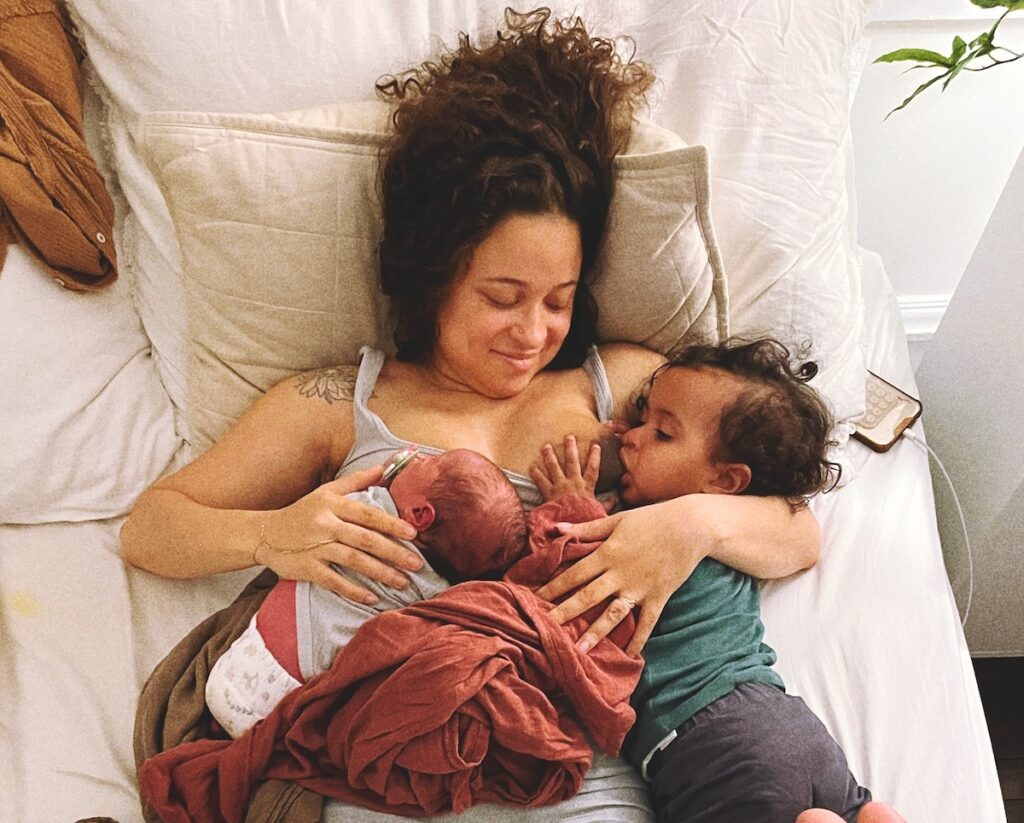
Cheyenne’s three birth experiences reflect a journey shaped by preparation, intuition, and evolving trust in her body and decision-making.
Her first birth was planned as an out-of-hospital birth center delivery with midwives. At 41 weeks and one day, she went in for a routine non-stress test at the hospital, expecting to return home afterward. Instead, the test revealed mild but regular contractions alongside fetal heart rate decelerations. After leaving the hospital and consulting by phone with her midwives, Cheyenne and her partner made the decision to return to the hospital for induction. At the time, Cheyenne had already been a birth worker for six years and was deeply familiar with the hospital and its staff. Although her midwives did not accompany clients to the hospital, she was able to receive care from a trusted midwifery and OB practice she knew personally. Labor progressed with cervical ripening using a Cook catheter, time in the tub, and dilation to eight centimeters. When her water was artificially ruptured, her baby’s heart rate dropped immediately, and an urgent cesarean section followed.
For her second birth, Cheyenne again chose midwifery care—this time with the only Black midwife operating an out-of-hospital birth center in Richmond at the time. Labor began spontaneously just before 40 weeks. She labored at home initially, including a vivid car ride while contracting en route to drop off her older child with a friend. Once at the birth center, she entered the water quickly and labored for an extended time in a quiet, calm environment. The experience was deeply inward and meditative; she spoke very little except to repeat spontaneous mantras that arose in the moment and helped her move through each contraction. After some time, her midwife encouraged more movement. Cheyenne rested briefly on the bed with her husband beside her, then stood to use the bathroom. As she stepped back into the hallway, she felt her baby descend rapidly and knew birth was imminent. She delivered in the hallway on a birth stool. Afterward, she was found to have a second-to-third-degree tear. Another midwife was called in to assess, and her primary midwife accompanied her to the hospital for repair.
Her third birth was planned as a home birth. With her previous midwife no longer practicing locally, Cheyenne chose a home birth midwife she felt deeply aligned with and hoped to avoid the hospital altogether. Labor began quickly on Thanksgiving night after returning home from dinner. What initially felt uncertain became unmistakably active labor within an hour. Contractions intensified rapidly, and her midwife arrived within a short window, along with childcare support. Upon examination, Cheyenne was already six to seven centimeters dilated with a very bulging bag of waters. The midwife suspected a possible foot or elbow presenting, and given that the baby had alternated between head-down and breech positions late in pregnancy, they made a swift decision to transfer to the hospital. By the time Cheyenne was admitted, she was fully dilated, and breech presentation was confirmed.
Although her care team prepared to advocate for a vaginal breech delivery, Cheyenne felt a clear internal sense that a cesarean was the right choice for this birth. She consented calmly, trusting her intuition. In the operating room, her friend and doula faced resistance from staff despite hospital policy allowing doulas to be present during cesarean births. The doula persisted, waiting outside the OR in proper attire until the anesthesiologist intervened and allowed her inside. Cheyenne was deeply grateful for her presence, particularly as she experienced intense, uncontrollable shaking—a recurring and distressing part of her prior cesarean recoveries. Having her doula there, holding her hand, grounding her, and speaking with her made the experience feel safer and less isolating.
As with all three of her births, Cheyenne did not know her baby’s sex until the moment of birth. When her baby was lifted above the surgical drape, her husband announced that they had a son—after two daughters—marking a powerful and joyful close to her birth journey.
Cheyenne Varner Bio
Cheyenne is a nationally recognized certified birth worker, health equity advocate, and illustrator. She is the founder of The Educated Birth and Everyday Birth Magazine, platforms dedicated to advancing reproductive health equity through inclusive educational tools and amplifying underrepresented stories. Her mission is to advance health equity by transforming how pregnancy, birth, and postpartum are taught about, understood, supported, and experienced. Connect with her at @cheyvarner on Instagram
Resources
- Take a Childbirth Class
- The Educated Birth
- The Birth Hour podcast
Needed
There is overwhelming evidence that higher standards of nutrition support fertility, birth outcomes, and lifelong health. Unfortunately, the prenatal vitamin industry is failing us, leaving 95% of us depleted during one of the most nutritionally demanding times in our lives. Most prenatal vitamins only provide bare minimum nutrition, while Needed goes beyond bare minimums with products that can meet the needs of our minds, bodies, and babies. I’m excited to partner with Needed and offer you a special discount. Get 20% off your first order with code BIRTHHOUR at thisisneeded.com.
I feel confident recommending Needed because their products are rigorously third-party tested and endorsed by over 15,000 women’s health experts. Needed’s prenatal multivitamin comes in two forms – capsules or a delicious vanilla powder. In addition to the prenatal multivitamin, Needed has created bundle options to meet your needs, not only during different stages of pregnancy but also while trying to conceive and postpartum. As a mom of three, I especially love their collagen, pre/probiotics and cognitive support supplement.
Head over to thisisneeded.com to find your perfect bundle and use code BIRTHHOUR for 20% off your first order and up to 40% off select plans. I’ve talked to so many Birth Hour listeners who have discovered Needed through the podcast and I love hearing the feedback that they are feeling better during their pregnancy and into postpartum since starting with Needed. That’s thisisneeded.com and use code BIRTHHOUR.
Listen to the Needed Experts podcast on Apple Podcasts or Spotify.
*These statements have not been evaluated by the Food and Drug Administration. This product is not intended to diagnose, treat, cure, or prevent any disease.
No Comments yet!